
Murder By Words: Land of opportunity
A Canadian asks:-
Americans: why does the Trump administration want to annex Canada, but not Mexico?
- Is it a racist thing (that Canada is a predominantly “white” Caucasian country, whereas Mexico is “brown”)?
- Is it because Canada is a stable country with much more cultural similarities to the US than Mexico? Canada and the US being mostly English speaking countries, whereas Mexico is more unstable and Spanish speaking?
- Is it a matter of how Henry Kissinger put it: “It may be dangerous to be America’s enemy, but to be America’s friend is fatal”
Trump has taken undue advantage of our friendship, and wants to annex us.
Mexico was never really US’s friend the way Canada was. In fact, Trump said that Mexico was not “sending its best and brightest across the border into the US, that they were felons and rapists”.
We asked the same question to all the best AIs on earth… They all refused to answer and just say this is a JOKE!
This does sound like a real conspiracy, is it not?

Anyway,
If Trump wants a 51st state so badly that he’s willing to annex Canada or Greenland, why doesn’t he convince Congress to make Puerto Rico a state since it’s already a U.S. territory?

Meanwhile,
Trump tariffs: Canada buying billboards in new ad campaign
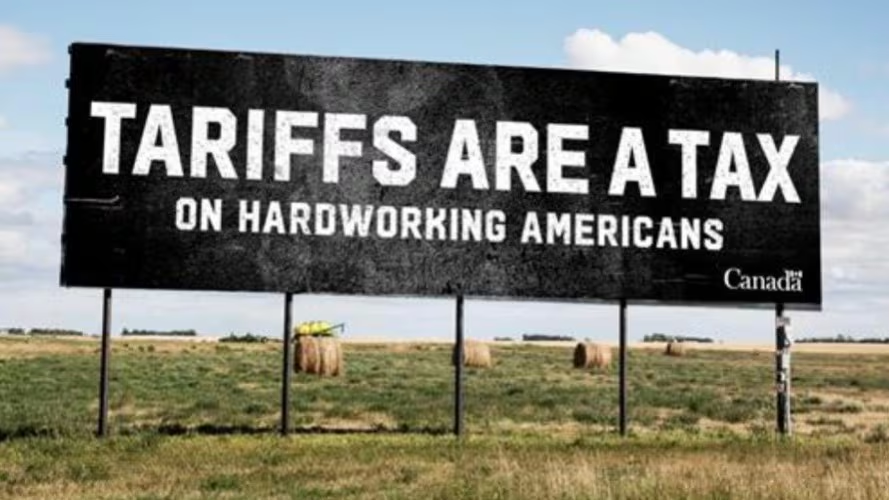
Canada will erect a series of “huge billboards” along highways in the U.S. as part of a campaign to sow public discontent with American tariffs, Foreign Affairs Minister Melanie Joly told CNN Friday.
The billboards will appear in 12 “red states,” the minister said, which include Florida, Nevada, Georgia, New Hampshire, Michigan and Ohio.
“We need to send a message to the American people for them to understand what’s at stake,” she said, calling them the “first victims” of U.S. President Donald Trump’s tariff war.
“Please, talk to your senators, talk to your House representatives,” she said.
Canada and the U.S. are in the throes of a trade war with both countries preparing for the approaching front, which will arrive on April 2.
On that day, Trump plans to impose reciprocal tariffs against all countries, including Canada. Canada has promised to respond if the U.S. doesn’t back down.
The last several weeks have been a slog of threats, executive orders and reversals.

On Feb. 1, Trump ordered 25 per cent tariffs on all imported Canadian goods, except energy and potash, which were to be taxed at 10 per cent. Two days later, he delayed the fees until March 4. Canada unveiled counter levies to come into effect the same day.
On March 6, two days after the tariffs came into effect, Trump paused the added tax on any goods covered under the Canada-United States-Mexico Agreement (CUSMA), also known as the USMCA south of the border. That exemption covers more than 98 per cent of imports from Canada.
On March 12, the U.S. imposed tariffs of 25 per cent on Canadian steel and aluminum products. Canada, in turn, imposed reciprocal tariffs on American steel and aluminum.
Trump has said the changes in his tariff scheme are an example of his flexibility. Joly said Canada delayed the second round of counter tariffs out of “good will,” but that the federal government is prepared to unleash its second round of levies attached to $125 billion in American goods on April 2.
So far, Canada has retaliated with tariffs on about $60 billion worth of American goods.
Canadian federal and provincial leaders have made various appeals to the U.S. to back down, both to its federal leaders and to the American people directly.

In addition to the trips to Washington, and meetings with the treasury and commerce secretaries, senior Canadian lawmakers have made countless appearances on American networks in an attempt to bring Trump’s constituents on side.
On Friday, Joly wasn’t discreet. “Send a message that you don’t want these tariffs, because no one will win,” she said, explicitly addressing the public.
Also facing a question on whether she believes Trump is seriously willing to use economic force to acquire Canada as a state, she said she does.
“People are mad. They are infuriated. Imagine the case of another country saying that they don’t recognize the borders of the U.S.,” she said.
“How would Americans react? They would say, ‘No way, it’s unacceptable.’”
Prime Minister Mark Carney has said he support dollar-for-dollar retaliation, but most recently admitted “there is a limit” to how Canada can respond, due to the varying sizes of the two economies.
“We are not going to take an action that we think is not ultimately going to influence the United States, and certainly not one that is outright harmful to Canada given the overall approach,” Carney said earlier this week on his first trip as prime minister.
An Honest Map of the United States


 Corporations Fleeing Canada? Companies considering Re-Domiciling to the U.S. could make sense for some, but most quickly learn it’s costly and complicated… and can even backfire Big Time
Whaddaya Say?