
The tyranny of work: jobs have become, for so many, a relentless, unsatisfying toil. Now is the time to challenge the traditional work ethic.
Here’s a breakdown of the key issues behind common criticism of Canada’s economic and labor market conditions:-
1. Work American Hours: Long Workweeks with Less Vacation
-
Canadians work longer hours than many Europeans, with an average workweek closer to the U.S. standard (around 40+ hours).
-
Unlike many European countries (e.g., France, Germany, Denmark), where 30-35 hour workweeks and generous vacation policies (4-6 weeks) are common, Canada’s labor standards are more aligned with the U.S., offering just 2-3 weeks of paid vacation for most workers.
-
Overtime culture is prevalent, especially in competitive industries, without the same level of worker protections seen in Europe.
2. Earn European Wages: Lower Salaries Compared to the U.S.
-
While Canadian wages are higher than some European nations (e.g., Spain, Italy), they are significantly lower than U.S. salaries for comparable jobs, especially in tech, finance, and healthcare.
-
High-paying industries in the U.S. often offer 30-50% higher salaries for similar roles, even accounting for currency differences.
-
Meanwhile, Canada’s tax burden is higher than the U.S. (though generally lower than parts of Europe), reducing take-home pay.

3. High Cost of Living (Worse Than Both?)
-
Housing costs in major Canadian cities (Toronto, Vancouver) rival or exceed those in expensive U.S. cities (e.g., NYC, SF) but without the same wage premium.
-
Groceries, telecom, and other essentials are more expensive than in the U.S. and many European countries due to limited competition and protectionist policies.
-
Unlike Europe, Canada lacks robust public services (e.g., cheap/free university, extensive transit) to offset costs.
4. Weak Productivity & Economic Stagnation
-
Canada’s productivity growth has lagged behind the U.S. and Europe for decades, limiting wage growth and innovation.
-
The economy relies heavily on real estate and natural resources rather than high-value industries, contributing to lower wages.
5. Healthcare: A Mixed Blessing
-
While Canada’s universal healthcare is a advantage over the U.S., wait times and underfunding strain the system. Unlike some European countries, Canada lacks universal pharmacare or dental coverage.
Let’s take a look at the scoop on the subject matter:-

Work American hours, earn European wages: Why Canada has the worst of both worlds
For a few years now, alarm bells have been sounding from Berlin to Canberra about how growth rates in per capita incomes around the developed world have stagnated relative to the United States. Ex-European Central Bank president Mario Draghi calls this an existential challenge for Europe, and it is why leaders such as U.K. Prime Minister Keir Starmer and German Chancellor Friedrich Merz now emphasize growth as a key priority.
Canada is no exception – but a little digging into the data suggests the origins of Canada’s woes might be more difficult to overcome. It is true that we earn on average as little as our European counterparts, but at present, we also work as many hours as Americans to get it. Our problem, then, is the worst of both worlds: neither high incomes nor the idle hours to compensate.
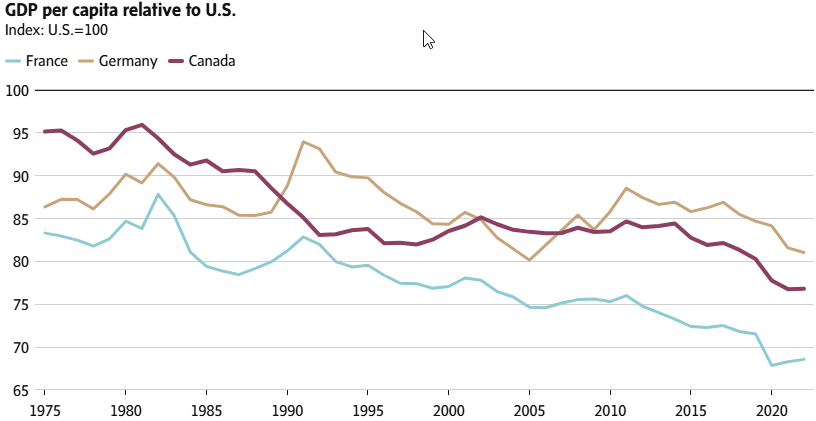
Since the 1970s, Canadian real GDP per capita (at purchasing power parity), like that of major European powers such as France and Germany, has been falling precipitously relative to the United States. After 2008’s great financial crisis, U.S. per capita growth has been about double that of Canada, about two-thirds higher than Germany and more than double that of France.
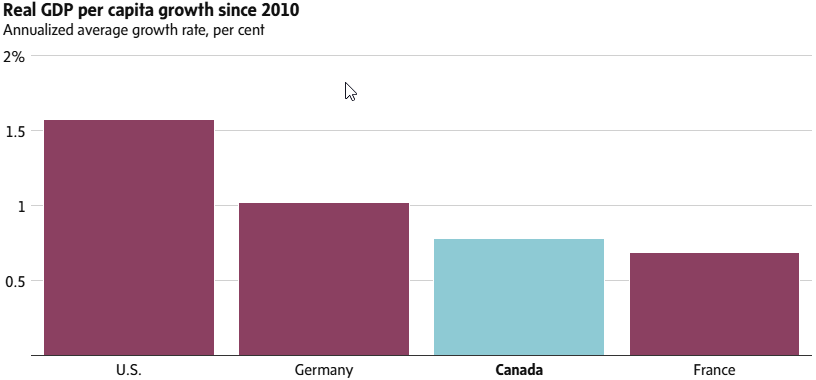
As a result, average real Canadian output per person (at purchasing power parity) has dropped from nearly equal to the U.S. in 1975 to almost 25 per cent less. This overarching pattern is broadly consistent across the developed world, but the timing and extent differ across countries – France has been relatively stagnant for decades, while Germany has done a better job keeping up. This has been the source of much panicked policy making in the wealthy capitals around the globe.
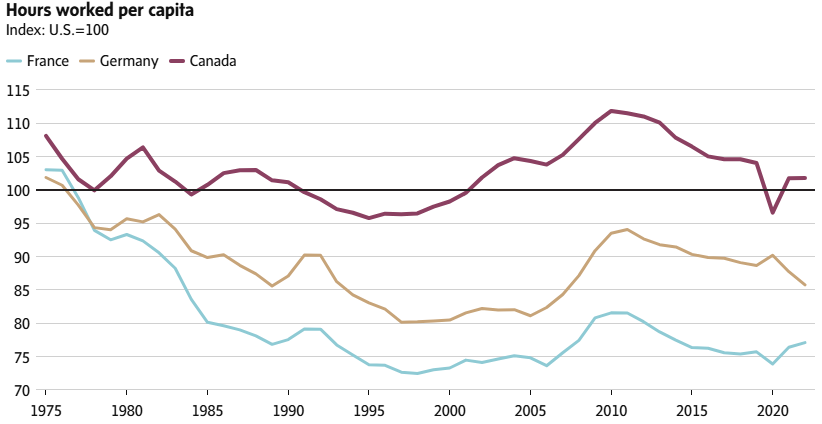
But while incomes have stagnated across the Northern Hemisphere, the underlying reasons are not all the same. Europeans work much less than North Americans. In the same period that U.S. per capita output growth has outpaced Europe, the number of hours the average European works has fallen dramatically by comparison. In 1975, an average French worker put in slightly more hours than her American counterpart, but by 2020, true to national stereotypes, she worked only three-quarters as much. This helps explain a sizable portion (though not necessarily the majority) of Europeans’ weak performance.
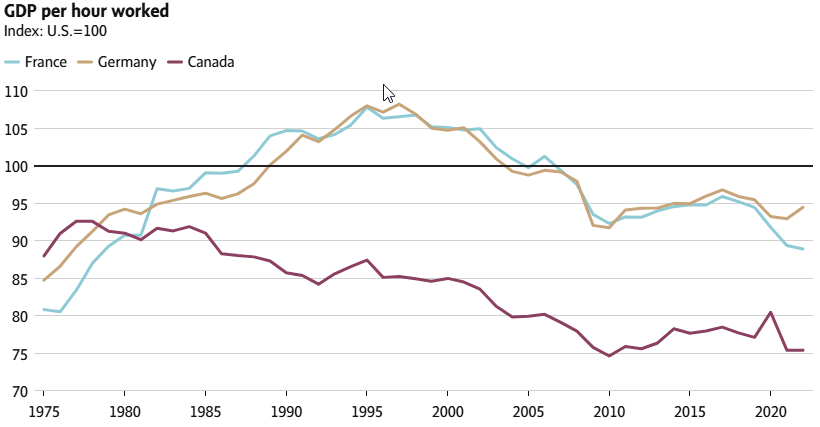
This is not so for Canada. Our incomes have also stagnated, but we cannot point to putting fewer hours in as the cause. For most of the 2000s, Canadians worked significantly more than Americans, and since the 1980s, we have worked about as much. One might be tempted to applaud our industrious nature if not for the fact that we have so little to show for it. This is the productivity problem in a nutshell – it is not how many hours of work that is the problem but rather what we get (or rather do not get) out of those hours that is the source of our economic woes.
The European problem of working fewer hours is a more manageable problem. Certain reasons for the decline in hours are easier to fix than others, but all imply relatively clear policy prescriptions. Bringing in immigrants to address an aging population may be more difficult than cutting restrictive labour market regulations because immigration remains a political choke point, but it is at least something tangible that we know works. To the extent that it stems from a cultural preference for leisure, one might argue that the working hours issue does not need to be addressed at all.
But Canada does not have this luxury. Such “low-hanging-fruit” strategies cannot improve the output we get out of the hours we already work, which is a far more complex result of our technological prowess, institutional quality and the efficiency with which we allocate resources. Standard prescriptions such as removing internal trade barriers, cutting red tape and incentivizing greater investment will help, but I can think of few (if any) historical case studies that suggest these would be sufficient to reverse our economic fortunes.
Throughout the global discussion, there has been a sense of kinship across developed countries – a notion that this problem is, at the very least, shared, and that perhaps the story is to some extent one of U.S. exceptionalism as opposed to domestic malaise. But this cohesive narrative masks important differences between individual countries and, unfortunately for Canada, looks like a bit of a false hope.
There is a wealth of work to do to understand the intricacies of this issue but for now the point is this: Canadians work a lot for relatively little. Americans can take pride in their staggering incomes, while Europeans can at least bask in the extra time they have on their hands. In this sense, our growth challenge is the worst of both worlds.

Why Does Canada End Up with the “Worst of Both”?
-
Proximity to the U.S.: Canada competes with the U.S. for talent but can’t match its wages or investment, while adopting similarly lax labor laws.
-
European-Style Taxes Without European-Style Benefits: Taxes are higher than in the U.S., but social services (childcare, transit, pensions) aren’t as comprehensive as in Europe.
-
Housing Crisis: A severe supply shortage has made homeownership unaffordable for younger Canadians, unlike in many European cities with better renter protections.
Canada’s economy sits in an awkward middle ground: it lacks the high wages and dynamism of the U.S. while missing the strong worker protections and social safety nets of Europe. For skilled professionals, this can feel like the “worst of both worlds” — long hours without the payoff of higher U.S. salaries or the work-life balance of Europe. However, Canada still offers benefits like immigration-friendly policies and universal healthcare, which some argue balance the scales.
So, what now?
Join European Union or become the 51st State?
Canada doesn’t like USA anymore! So they moved to Europe!


 Canada’s Immigration Crisis Deepens Under The Century Initiative: Liberals Conspiracy to increase Population to 100 million, a number we simply do not have the resources to sustain… What more with annihilation of major industries as a result of Trump Tariffs
Whaddaya Say?